Can Art & Poetry Serve A Purpose Without the Story Behind It?

Posted by: • Date:

When I was a young teen, I always kept a small spiral notebook and several Bic pens close at hand in the event I should get the urge to dash off some prose. Society was different back then. It was before “After School Specials” and was when the Victorian-Era attitude that “Children should be seen and not heard” was still pretty much the norm. Anyone who knew me back then would probably tell you I was this happy-go-lucky kid, always ready with a smile and some absurd observation geared to make people laugh and forget their woes. Very few, if any, had a clue what was really going on in my mind and my life. Of course, the same thing was likely true for the other kids at the schools I attended. It’s just the way things were back then. But keeping up the façade of “all is right with the world” was at times an unbearable burden and that’s where my poetry came in

Writing prose was a life-saving outlet back then in the same way that visual art serves me today. It allowed me to vent, to dream, to cry, to wonder, to argue and even to pretend. Early on, I discovered that I had the natural ability to assume the literary voice of any character I read about in a book, saw in a movie, or dreamed up from scratch and write about their feelings as if they were my own. It was really no different than what most authors and actors do, but because I recorded these creative ramblings in a book that had the word “Diary” on it’s cover, anyone who picked it up to read assumed it was all about me. Of course, I hadn’t intended for anyone else to read it but it happened nonetheless, each time causing great suspicion and worry or ruffled feathers or outrage on the part of the unauthorized reader(s). Had they only asked me what the poems were about or what inspired them rather than jumping to erroneous conclusions, a lot of grief could have been avoided. But, as I was still considered a “child” then, it never occurred to my elders that I could possibly have something intelligent to say or that my feelings mattered.

Thank God our society (for the most part) has finally woken up to recognize not only that children DO have opinions and feelings and that they deserve the respect to be heard, but also, most people today realize the importance of being able to share their feelings with others. As a society, we’ve still got work to do in learning how to listen to each other but it is getting better, one individual at a time. And as long as we’re moving forward in the right direction, regardless of how slowly, there is hope.

For tonight’s Freebies, along with a few empty frames for you to fill with your own content, I’ve mixed together a couple of my shorter prose, written when I was teenager with decorative backgrounds I created close to half a century later. These poems served their purpose for me at the time they were written and so now I hope they can serve some purpose for you. It really doesn’t matter any more what or who I was actually thinking about so feel free to interpret them in whatever way you choose.

Free Icons and Clip-Art of the Day

The following images are either full or reduced size previews. Simply right-click (or control-click) on the preview to save the image(s) of your choice to your desktop. (Unless otherwise noted, downloads are 512px X 512px in .png format). As always, usage of any of the images offered on this blog are free for your personal use while subject to the limitations of my Creative Commons Non-Commercial – Attribution – No Derivatives 3.0 license. (See sidebar for details)

Children Play

“Children Play Games” – 1973 by Leslie Sigal Javorek – (600 x 309px)

Nouveau-FrameNouveau Frame 2

“Art Nouveau Style Frames” – Download size: (600 x 763px)
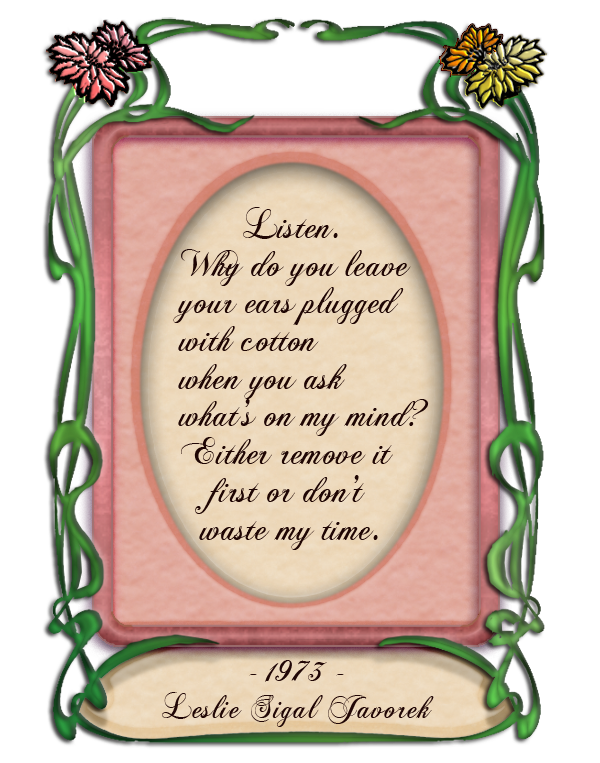
Listen

“Listen” – 1973 by Leslie Sigal Javorek – (600 x 763px)
Book Opening

“Book Opening” (600 x 595px)

Add to FacebookAdd to DiggAdd to Del.icio.usAdd to StumbleuponAdd to RedditAdd to BlinklistAdd to TwitterAdd to TechnoratiAdd to Yahoo BuzzAdd to Newsvine

Pinkies Up in Appreciation of You

Posted by: • Date:

When I was a kid, the phrase “proper etiquette” was never too far off the tip of my mother’s, teacher’s, and other authority figure’s tongue. There was just this set of certain rules you had to follow else you’d be considered uncivilized and therefore shunned from society, along with your parents who obviously were at fault for not teaching you better. So I learned the rules, such as to always place my napkin on my lap, never put my elbows on the dining room table, send thank you notes to those I received gifts from within 24 hours, wear white gloves when going out to a restaurant, and never wear a white skirt or slacks before Memorial Day or after Labor Day. There were a couple hundred other rules just like that, as well.

When I became a teenager in the mid-1960’s, at the height of Haight-Ashbury’s heyday, I rebelled against the rigid rules of my parent’s generation (which seemed to have gone back to pre-Edwardian manners). I had a problem with even the concept of anyone making rules of how I should dress or with what hand I could hold my fork as such intrusions on my personal liberty seemed to me to be completely against nature, despite how trivial those particular rules were. The fact that no actual harm to anyone or anything would occur if such rules were not followed – other than harm inflicted by those intent on punishing such “wrong” behavior – struck me as grossly unjust and a symptom of an unimaginative society trying to place everyone into their little labeled boxes so they (society) wouldn’t have to think too hard or have to actually examine the logic of their beliefs. I was hardly alone in that rebellion as even a quick skim through any news archives around the world will attest to.

Every generation since the time of Plato, if not before, has recognized that teenagers, in general, feel their parent’s generation are “old fashioned” and overly strict and that they (the younger ones) are far more intelligent. Yet it has been relatively rare for the specific focus of such rebellion to outlast not only the teen years but to continue on through subsequent generations as well. I’ve no formal education in this area, but I would venture a guess that the reason for this rarity is simply due to the fact that on the road to maturity, we experience the natural consequences of what happens when we or others do not follow certain rules of civility, until it finally leads to an “Aha!” moment – and then the cycle begins again with us as the old-fashioned parents instead.

The rebellion against society that came to the forefront in the 1960’s was far more complicated that this “usual” type of teenage angst and rejection of tradition though, as it included far larger issues such as racial and gender equality, isolationism, responsibility for our neighbors, and even the very existence of God. In reality, those issues had actually been in the making since the 1840’s when Darwin and the Industrial Age gave rise and opportunity to ponder such existential questions. Thereafter, it was only due to the advances in communications technology (i.e. television, transatlantic telephones, etc.) that permitted the questions and debates in response to them, to be shared with the masses. And most spectacularly of all was that, for the first time in history, the masses were largely literate and educated enough to join in the conversation, which in turn forced serious consideration and decisions upon our elders and our governments.

Fifty years later, we’ve come a long way but as is typical for humans, it’s been a journey of three steps forward and two steps back. So we’ve still got a long, long way to go in figuring out which rules of society go to the heart of what it takes for individuals to live and work peacefully and productively together and which rules only serve to divide us. For isn’t that the weight we should be measuring such rules by?

With that standard in mind, On my own personal journey to maturity, I re-evaluated each of those rules of etiquette embodied in books by the likes of Emily Post, Amy Vanderbilt, and Letitia Baldridge. In raising my own child, I threw out the white gloves and rules about what color you could wear at what time of year and such but I did return to the “rules” about writing Thank You Notes and other such niceties as I came to understand the importance of taking the time to let people know you appreciate their acts of kindness and generosity. And like many of my generation, I’ve tried to take this concept even further by ensuring I tell people that I simply appreciate them – for who they are – and their presence in my life. For it is through these small but sincere gestures that we all have the power to help another feel good and to make the world a little more pleasant to live in. It is an act which tends to infect the actor, the receiver and even those who merely witnessed its’ occurrence. Now that’s an epidemic I’d love to spread!

Free Icons of the Day

The following images are either full or reduced size previews. Simply right-click (or control-click) on the preview to save the image(s) of your choice to your desktop. (Unless otherwise noted, downloads are 512px X 512px in .png format). As always, usage of any of the images offered on this blog are free for your personal use while subject to the limitations of my Creative Commons Non-Commercial – Attribution – No Derivatives 3.0 license. (See sidebar for details)

ThankYou-1

ThankYou-3

ThankYou-4

Add to FacebookAdd to DiggAdd to Del.icio.usAdd to StumbleuponAdd to RedditAdd to BlinklistAdd to TwitterAdd to TechnoratiAdd to Yahoo BuzzAdd to Newsvine

It’s Always Mother’s Day In Heaven

Posted by: • Date:

I used to dread Mother’s Day. Like way too many people, I had a difficult childhood growing up and as an adult, I had an inconsistent relationship with my mother. At times it was really wonderful but more often, it was tumultuous. My mother was an absolutely beautiful woman – she looked like a fashion model – she was bright, vivacious, had a great sense of humor, adored animals, volunteered as a Brownie and Girl Scout Counselor, volunteered at the local Veterans Hospital, wrote poetry, loved going to the movies, art museums, live theater, and reading trashy novels. Yet I don’t think that she ever was genuinely happy or comfortable inside her skin. There was always an undercurrent of fear and anger and estrangement. She was extremely critical of her children – on purpose. She believed parents are supposed to point out every single error their child may make or non-perfect trait their child may have. I never once doubted that her intent was good – she truly wanted to help us to be the best we could be – but her way of going about it could really hurt. Mom never learned how to simply observe and listen to her children (or her husbands for that matter) and so was incapable of providing guidance in a subtle, respectful way. Essentially, she never figured out how to differentiate between herself and her family. What I mean by that is, there is a huge difference between recognizing your child may have inherited this or that physical and non-physical traits from you and keeping in mind that you are responsible for keeping them healthy and safe and teaching them the skills and values needed to stand on their own as a kind, wise, loving adult and contributing member to society – versus – thinking your children are an actual extension of yourself. My Mom was unable to grasp this concept and I think she was aware that there was some great important “secret” she was missing and was deeply troubled as a result.

Even as a very young child, a part of me always understood, instinctively, that my mother was hurting and “broken” in some way and I knew that it wasn’t totally her fault. Although I loved her very much and felt great compassion for her, at the same time, I was always terrified around my mother, even as an adult, as I never knew when she would suddenly change from my gorgeous, fun “Momma” to the screaming, violent stranger that lived deep inside her. It got so bad that when I was 14, I was placed in a Foster Home for a year (with a very loving family whom I remain close to even to this day, forty years later.) At 17, I moved out on my own, 1500 miles away, as I feared for my life. Yet I never stopped loving my Mom. I kept in touch with her through occasional letters and phone calls every couple of weeks and we actually were able to grow closer that way from a safe distance. But even then, Mother’s Day was always the worst day of the year, regardless of where I lived. Perhaps it was because of her insecurities as a person and especially as a mother, that made Momma pin such intense importance to the day. Whatever, I knew that for the last few weeks of April, she would begin the harping, begging, then screaming and finally the “silent treatment” when she realized that I would not be coming down to Florida to see her. It was both heartbreaking and aggravating and got worse every year but I knew that it was for the best in the long run that I stay far away.

It’s been a dozen years now since my Mom tragically passed away at a relatively early age. Now, rather than dreading Mother’s Day and trembling inside with terror, I find myself with a lump in my throat and tears in my eyes, and praying that she can see me and hear me and feel what’s inside my heart. Not a day has gone by in my entire life that I have not spent a significant amount of time thinking about my Mom. Time, distance, and having to face my own mortality has been kind when it comes to my memories and relationship with my Mother. I haven’t forgotten there were bad times, but 90% of the time, I’m thinking about the good times. Although my Mom thought she was a complete failure as a mother, the fact she indeed didn’t always have the best of parenting skills, and found it impossible to live by what she preached, I marvel at how much my mother really taught me and how much I’ve relied on her words of wisdom in my adult life and in raising my son. I talk to her all the time these days – inside my head and inside my heart – and I feel like she is with me – not as she was, but as she wanted to be: relaxed, happy, wise, content, and supportive.

Is there such a thing as Heaven after we die? Logistically, I have a very hard time trying to figure out how that would work and where it may be and even why it would even exist. But spiritually, I like to think that Heaven is all around and within us and that Momma is finally at peace and enjoying Mother’s Day – with me right beside her – every single day.

Happy Mother’s Day, my friends.

Free Icons of the Day

The following images are either full or reduced size previews. Simply right-click (or control-click) on the preview to save the image(s) of your choice to your desktop. (Unless otherwise noted, downloads are 512px X 512px in .png format). As always, usage of any of the images offered on this blog are free for your personal use while subject to the limitations of my Creative Commons Non-Commercial – Attribution – No Derivatives 3.0 license. (See sidebar for details)

FantasyPansies

HappyMother'sDay

Katie-Geranium

HappyMother'sDay2

Add to FacebookAdd to DiggAdd to Del.icio.usAdd to StumbleuponAdd to RedditAdd to BlinklistAdd to TwitterAdd to TechnoratiAdd to Yahoo BuzzAdd to Newsvine